South Korea eSIM travel hero

South Korea 🇰🇷 eSIM — keep up with a country that runs at fiber-optic speed

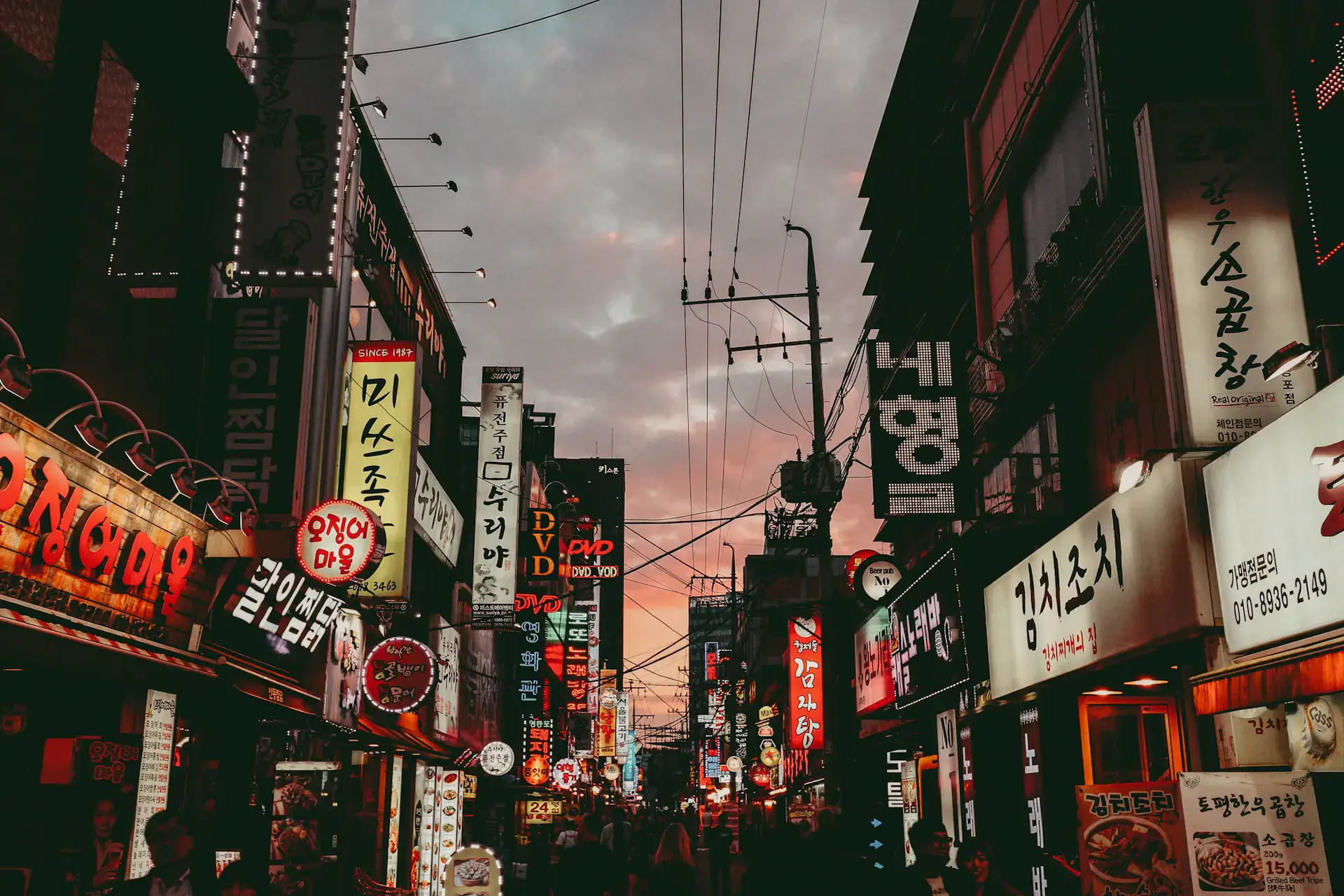
South Korea does not just have fast internet — it has built an entire culture around permanent connectivity. KakaoTalk pings arrive before you finish your thought. Naver Maps recalculates your Seoul subway route faster than the doors close. Baemin delivers your tteokbokki before you've decided which K-drama to watch. A South Korea eSIM means you arrive already wired into this — no airport SIM counter, no pocket WiFi, no gaps in the feed.

Why travelers choose this destination

South Korea consistently ranks among the world's top nations for mobile network speed and 5G coverage. SKT (SK Telecom), KT (formerly Korea Telecom), and LG U+ have blanketed Seoul, Busan, Daegu, Incheon, and Gwangju with dense 5G infrastructure. Even in the mountain national parks and on Jeju Island, coverage holds up far better than you might expect from a country with Korea's terrain. Install your eSIM profile before you board; activate data when you land at Incheon and you'll be on Naver Maps before you reach the AREX station.

South Korea eSIM plans — pick your GB, scan the QR

Instant QR delivery · 5G/4G LTE · Seoul, Busan, Jeju & nationwide · No SIM swap

Instant activation • No physical SIM

KakaoTalk, Naver Maps, and why offline Korea is a different country

KakaoTalk is not an app in South Korea — it is infrastructure. Your Airbnb host will message you through it, restaurants share their menus on Kakao, and taxi drivers confirm pickup via KakaoTalk. Setting up KakaoTalk requires a data connection, and once you have it, you're operating at the same frequency as everyone around you. Beyond Kakao, Naver Maps is the navigation tool of choice for Koreans — Google Maps exists here but lacks the real-time data integration (traffic, bus ETAs, subway transfers) that Naver has baked in for a decade. Coupang and Baemin for food delivery, Kakao Taxi for rides, and Papago for translation are the other apps that benefit from a live data connection. None of this works well on a tourist SIM with throttled speeds or spotty coverage. A proper eSIM data plan, sized right for your trip, is the difference between navigating Korea like a traveler and navigating it like a local.

Seoul's subway system is one of the most complex and efficient in the world — 22 lines, 700+ stations, and a city of 10 million people moving through it daily. The Seoul Metro app (and Naver Maps, which integrates subway routing) uses real-time data for line status, platform transfers, and last-train advisories. K-pop concert logistics deserve their own paragraph: fandom culture here means fan cams, Melon streaming to identify which song is coming next, fan café updates, and Twitter/X real-time posting from inside the venue. The venues (KSPO Dome, KINTEX, Olympic Park) are large enough that without data, you are navigating blind in a crowd of 15,000 people who all know exactly where they are going. Data is not a luxury at a Korean concert — it is situational awareness.

Jeju Island is its own experience. Connected by flight (30 min from Seoul Gimpo) or ferry, Jeju has coverage across most of the island's resort areas, coastal roads, and Hallasan mountain trails. The rental car ecosystem on Jeju depends heavily on navigation apps — the roads are well-maintained but the addresses in rural Jeju can be baffling to non-Korean speakers without a live map. In Busan, the combination of beaches (Haeundae, Gwangalli), markets (Jagalchi, BIFF Square), and the KTX train from Seoul makes for a natural data-heavy trip. The KTX Seoul–Busan route (about 2.5 hours) has solid coverage for most of the journey and is a reasonable place to catch up on whatever you were watching on Netflix before your connection interrupted you.

South Korea eSIM questions, answered

Does Google Maps work in South Korea?

Google Maps works for basic navigation and Points of Interest, but it has a significant limitation in Korea: due to South Korean regulations, Google cannot use detailed local map data for driving navigation. For subway, walking, and detailed local navigation, Naver Maps or Kakao Maps are far superior. Download Naver Maps before you arrive.

Can I use KakaoTalk with a South Korea eSIM?

Yes, absolutely. KakaoTalk works over any data connection — you just need an active data plan to send messages, make voice calls, and receive notifications. Setting up KakaoTalk on arrival with a live data connection takes about two minutes.

Will the eSIM work during a K-pop concert or large event?

eSIM data will work at Korean concert venues, though network congestion during sold-out shows (20,000+ people streaming simultaneously) can slow speeds. Download any essential apps, fan cams, or schedules before you arrive at the venue. Data connectivity will generally be available for messaging and light use even at peak congestion.

What is coverage like on Jeju Island?

Jeju Island has excellent 4G/5G coverage across the main resort areas (Jeju City, Seogwipo), coastal roads, and most tourist attractions including Hallasan National Park. Remote hiking trails on Hallasan's upper reaches can have reduced coverage. For driving Jeju, Naver Maps on a live data plan is essentially mandatory.

Does the eSIM work on the KTX from Seoul to Busan?

Yes, for the majority of the journey. The Seoul–Busan KTX corridor is well-covered by Korean carriers. Signal may dip briefly in tunnels through the mountain sections, but you will have workable connectivity for streaming and messaging throughout most of the 2.5-hour trip.

Is Naver Maps better than Google Maps in Korea?

For practical navigation in South Korea, yes — Naver Maps has real-time bus ETAs, integrated subway transfers with platform and exit numbers, and accurate driving routing that Google Maps currently cannot offer due to Korean data regulations. Kakao Maps is also excellent and slightly more popular for driving.

How much data do I need for a week in Seoul?

A week of active Seoul travel — Naver Maps navigation, KakaoTalk, social media, and some Melon streaming — typically runs 5–10 GB. If you are shooting content, K-pop streaming, or tethering a laptop for remote work from a café, budget 15–20 GB. Korean café culture (the PC bang scene aside) is very work-friendly and WiFi is widely available in most cafés.

Does a Korean eSIM work in PC bangs (gaming cafés)?

PC bangs (PC방) have their own wired internet — you would use the in-house connection for gaming and browsing on those machines. Your eSIM is for your personal device. Most PC bangs also have solid WiFi, so you can supplement with your eSIM data when using your own phone.

What about coverage between Seoul and the DMZ?

The DMZ tour routes from Seoul (via Dorasan Station or Joint Security Area tours) pass through areas with good 4G coverage. The DMZ itself and the Joint Security Area are restricted zones where photography and device use may be limited by tour rules. Coverage exists but follow your guide's instructions on device use.

Seoul is waiting, and it does not slow down for anyone

Pick your data plan, get the QR, and be on Naver Maps before you reach the AREX platform.

Explore all destinations